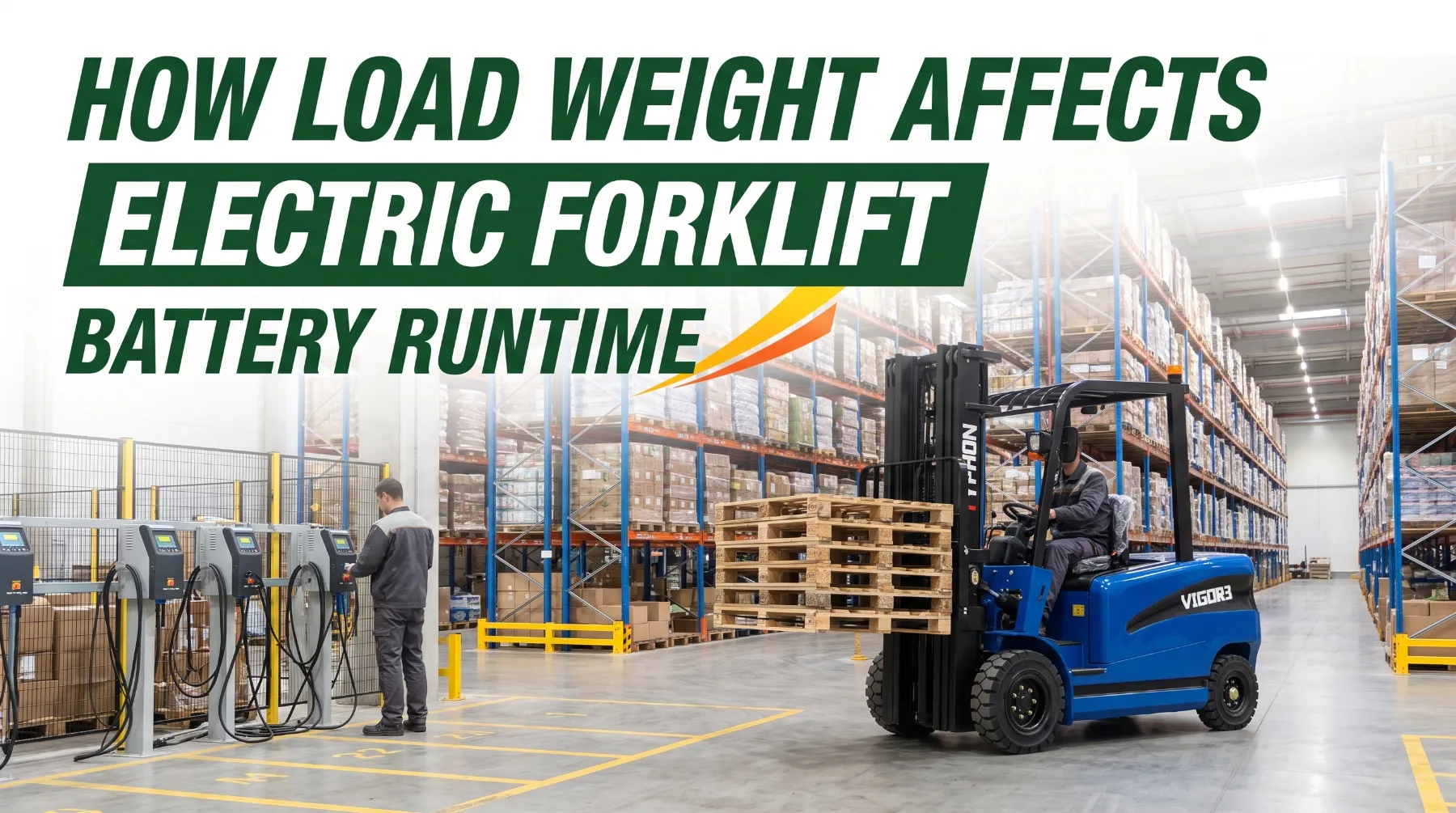
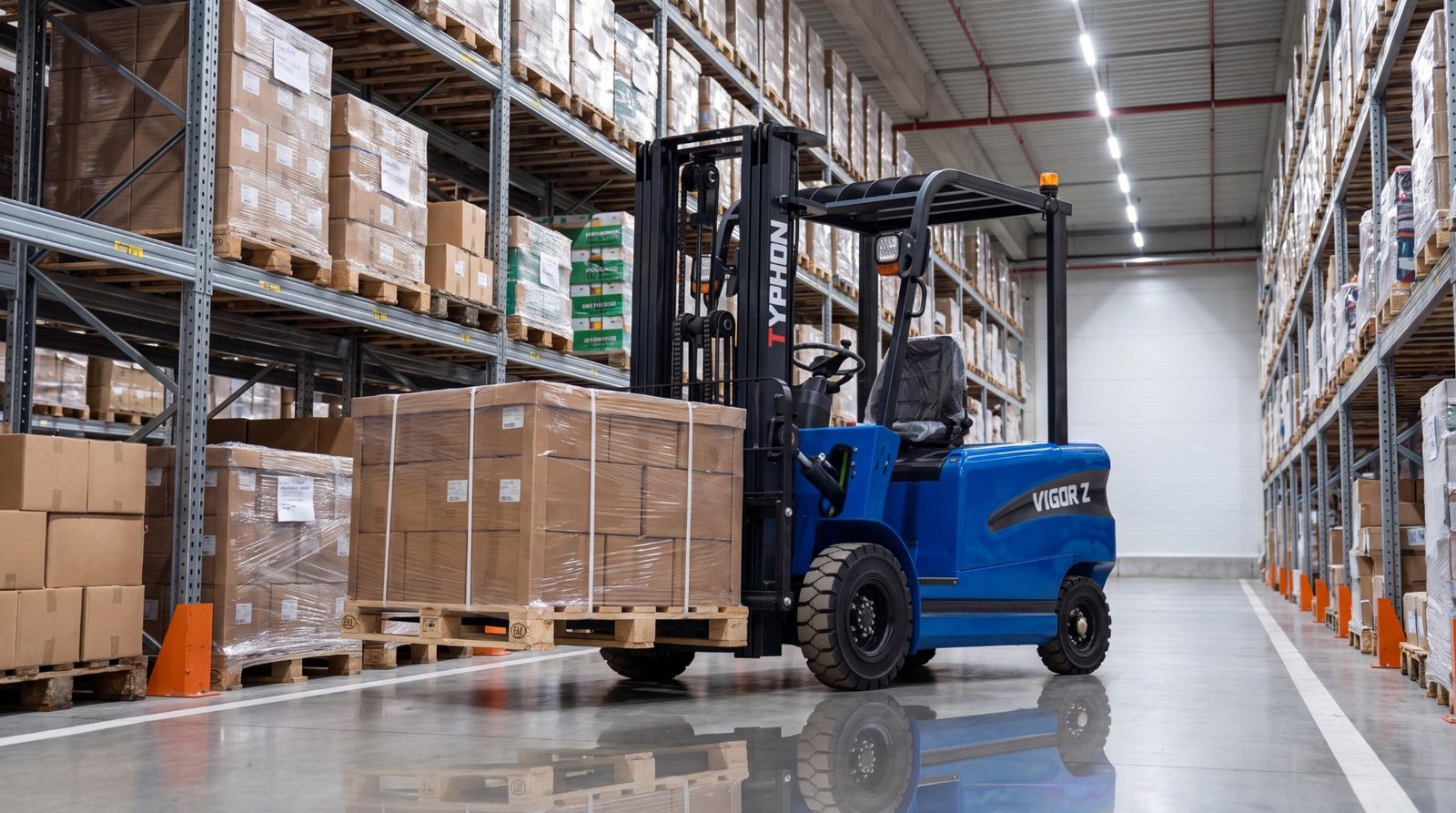
An electric forklift’s battery runtime is directly affected by the load it carries throughout a shift. As load weight increases, the traction motor and hydraulic system require more electrical power to accelerate the machine, maintain travel speed, raise the forks, and handle the load. The battery must supply higher current to meet these demands, increasing energy consumption per operating cycle. Repeatedly moving heavy loads can therefore reduce available runtime significantly, even when the battery is in good condition. The effect becomes more pronounced when the forklift operates with frequent lifting, acceleration, reversing, or other high-demand functions.
Load weight also interacts with duty cycle, travel distance, operating speed, and terrain to determine total energy use. Carrying heavy pallets over long travel paths or up inclines increases traction demand, while frequent lifting cycles increase hydraulic motor or pump demand and draw additional energy from the battery. Keeping loads within the forklift’s rated capacity, minimizing unnecessary travel and acceleration, maintaining correct tire pressure, and servicing the battery and electrical system can help control energy consumption. Effective load management is therefore essential for maintaining predictable battery runtime, reducing charging interruptions, and getting more productive hours from each charge.
How the Battery Powers the Forklift
An electric forklift runs everything off one power source: the battery. That battery feeds two main draws. The first is the hydraulic system, which raises, lowers, and tilts the mast to lift and place loads. The second is the drive system, the motors that move the machine across the floor and up ramps.
Both systems convert stored electrical energy into work, and both discharge the battery in direct proportion to how hard they labor. A light lift on level ground sips power slowly. A heavy lift, or a hard climb, pulls current fast. Keep this principle in mind, because nearly every effect of load weight below traces back to it: the harder the hydraulics and drive motors work, the quicker the battery empties.
Key takeaway: The battery powers both the hydraulics and the drive motors, and it discharges in proportion to how hard those systems work.
How Heavier Loads Increase Current Draw
Load weight is pure resistance to the forklift's systems. When the machine lifts a light pallet, the hydraulic pump meets little resistance, so the motor driving it draws modest current. Load the forks toward the machine's rated capacity, and the pressure needed to raise that weight climbs steeply. To build that pressure, the electric motor has to pull far more current from the battery.
The same holds true for driving. Moving a loaded machine takes more force than moving an empty one, so the drive motors draw more current to accelerate and maintain speed with weight on the forks. More current draw means the battery gives up its stored energy faster. That's the core relationship: heavier loads force the motors to work harder, harder work pulls more current, and more current drains the battery sooner.
Key takeaway: Heavier loads raise the current the hydraulic and drive motors pull from the battery, and higher current draw drains stored energy faster.
The Link Between Load Weight and Discharge Rate
A battery holds a fixed amount of energy, usually measured in amp-hours. How long that energy lasts depends on how quickly you draw it down, and load weight is a direct lever on that discharge rate. Run the machine light, and the current stays modest, so the battery discharges slowly and runtime stretches across the shift. Run it heavy, and the elevated current empties the same battery in noticeably less time.
The relationship isn't always a clean one-to-one, but the direction is dependable and worth planning around: as average load weight rises, usable runtime falls. A forklift moving loads near its rated capacity all day will simply not last as long on a charge as the same machine handling light loads. When you estimate how far a battery will carry a machine, the typical weight it moves belongs at the center of that calculation, not as an afterthought.
Key takeaway: The battery holds fixed energy, so a higher average load weight raises the discharge rate and cuts usable runtime from the same charge.
How Duty Cycle and Lift Frequency Compound the Effect
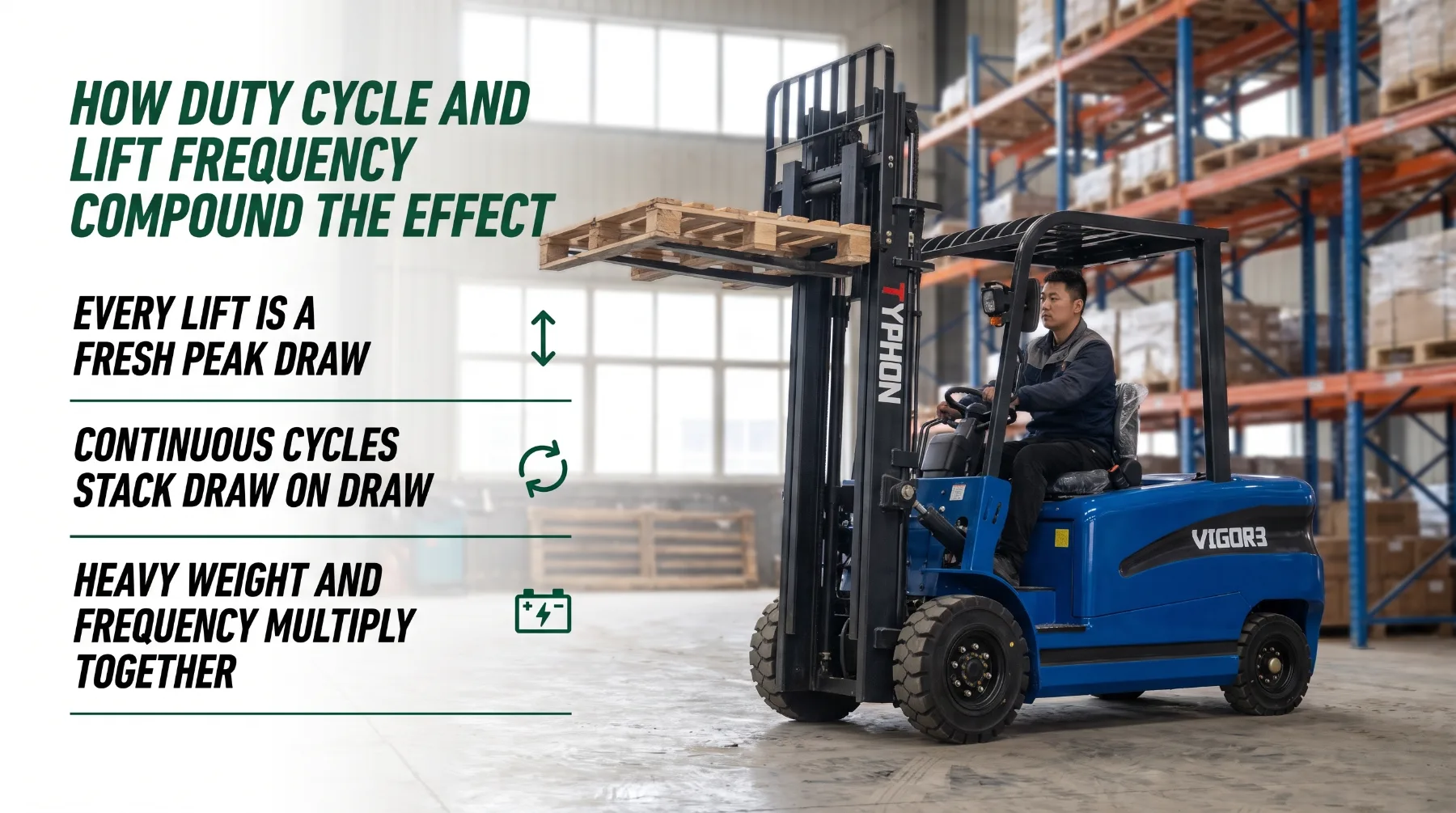
A single heavy lift barely dents the battery. The trouble comes from repetition. Duty cycle describes how continuously the machine works, and lift frequency describes how many times it raises a load in an hour, and together they decide how often the battery faces those peak current draws.
Raising the mast is one of the most energy-intensive things a forklift does, since the hydraulics fight gravity on every lift. A machine that lifts a heavy load once and then sits gives the battery long stretches of low demand to recover pace. A machine cycling near-continuously, lifting, placing, and reaching for the next load with barely a pause, stacks peak draw upon peak draw with no relief. Layer heavy weight onto a high lift frequency, and the two multiply: each lift costs more current because of the weight, and there are far more of those costly lifts in every hour. That combination drains a battery far faster than either factor alone.
Key takeaway: Heavy loads and frequent lifting compound each other, since a demanding duty cycle repeats the costliest current draws over and over with little recovery.
The Impact of Travel Distance and Inclines Under Load
Lifting isn't the only draw that weight makes heavier. Every foot the machine travels with a load on the forks costs current, and the farther it travels, the more energy the drive motors consume. A layout that forces long hauls between pickup and drop-off will burn through a charge faster than a tight, well-organized one, and adding load weight raises the cost of every one of those trips.
Inclines sharpen the effect dramatically. Driving a loaded machine up a ramp forces the drive motors to move both the forklift and its load against gravity, which spikes current draw well above what level travel demands. A steep or frequent climb with a heavy load is among the hardest work an electric forklift does, and the battery pays for it directly. Long travel distances and grades, combined with heavy loads, can quietly account for a large share of a shift's energy use, so they deserve real attention when runtime falls short.
Key takeaway: Loaded travel and especially inclines raise drive-motor current sharply, so long hauls and ramps under heavy loads consume a large share of battery energy.
Tips for Managing Load Weight to Extend Runtime
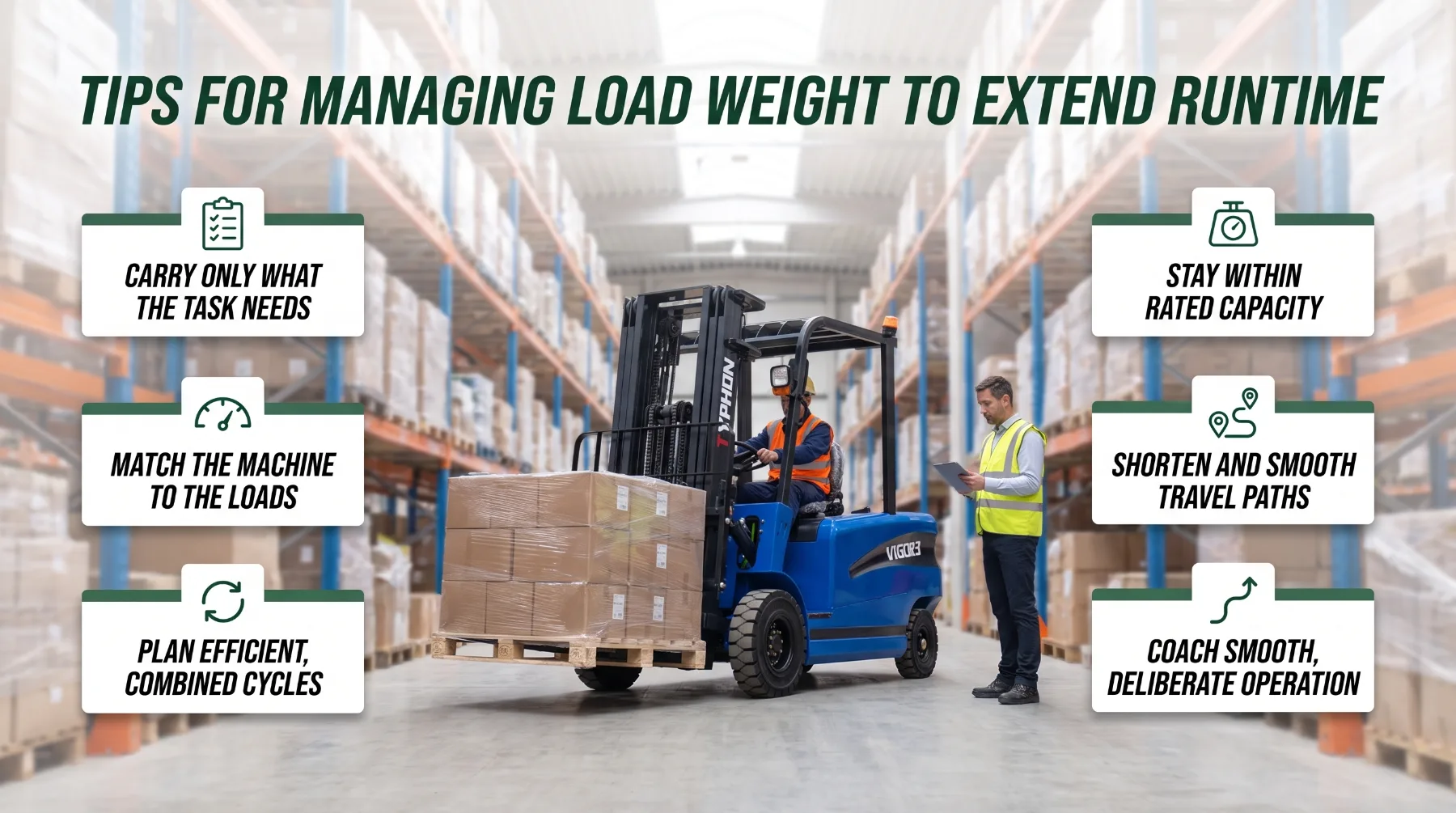
You control more of your runtime than the battery's rating alone suggests. A handful of deliberate habits keep current draw in check and stretch every charge:
- Carry only what the task needs. Staging just the load required for the immediate job, rather than moving weight "just in case," keeps each cycle efficient.
- Stay within rated capacity. Overloading forces the motors to pull heavy current on every move, drains the battery faster, and creates a serious safety hazard. It never pays off.
- Match the machine to the loads. Assign a forklift whose capacity suits its typical work, so it isn't straining near its limit all day.
- Shorten and smooth travel paths. Organizing the layout to reduce distance and avoid unnecessary ramps cuts the drive-motor draw that makes weight worse.
- Plan efficient cycles. Combining moves and reducing needless lifting and repositioning lowers how often the battery faces peak demand.
- Coach smooth operation. Deliberate acceleration and controlled lifting draw less current than aggressive, jerky inputs, protecting runtime on every task.
These steps cost nothing but attention, and together they recover a meaningful share of the runtime that heavy, careless handling quietly drains.
Key takeaway: Loading sensibly, right-sizing the machine, shortening travel, and coaching smooth operation all cut current draw and extend runtime without slowing real work.
Battery Maintenance Considerations
Even with disciplined operation, a poorly maintained battery will fall short of its potential runtime. Sound maintenance keeps the pack delivering the full capacity you paid for. Consistent, complete charge cycles matter most, since interrupting charges or returning a machine to work only partly charged means it starts the day with less energy to spend against those heavy loads. Follow the manufacturer's charging guidance and allow a full cycle whenever possible.
For lead-acid batteries, correct watering and clean, tight terminal connections keep the pack healthy and holding capacity, while neglect speeds the decline. Lithium-ion packs ask less routine care but still reward proper charging habits and sensible temperature management, since cold conditions and heavy demand both reduce what a battery can deliver. Track each battery's runtime over time as well. A pack that steadily delivers less across months is aging, and spotting that trend early lets you plan a replacement before it disrupts a shift rather than after.
Key takeaway: Full charge cycles, proper upkeep for your battery type, and tracking runtime over time keep the pack delivering its full capacity against heavy loads.
Conclusion
Load weight is a major factor in electric forklift battery energy consumption because payload directly affects the electrical demand of both the traction motors and hydraulic system. Heavier loads increase the torque required from the drive motors during acceleration and travel while also increasing hydraulic pressure and motor current during lifting, resulting in higher instantaneous power demand and greater battery discharge. The effect becomes more significant when heavy loads are handled repeatedly because frequent lifting, acceleration, braking, and direction changes increase the cumulative energy consumed over the duty cycle. Travel distance, operating speed, surface resistance, and inclines can further increase traction energy requirements, particularly when the forklift carries high payloads over long routes or grades. If the forklift is consistently operated near or above its rated capacity, higher current demand can increase battery heating, reduce available runtime, and accelerate battery degradation. Efficient operation therefore requires matching payload to the forklift's rated capacity, minimizing unnecessary travel and idle operation, using smooth acceleration and lifting techniques, and selecting routes that reduce grades and travel distance where practical. Battery condition, charging practices, tire condition, hydraulic-system efficiency, and drivetrain maintenance also affect energy consumption because electrical losses and mechanical resistance determine how much stored energy is converted into useful work. Evaluating payload, lift frequency, travel distance, grade, operating speed, and duty cycle together provides a more accurate basis for estimating electric forklift runtime than battery capacity alone.
Frequently Asked Questions
Why does my electric forklift battery drain faster on some days than others?
Because runtime tracks directly with how hard the machine works, and load weight is the biggest factor. On days spent moving heavy loads near the machine's rated capacity, the hydraulic and drive motors pull far more current on every lift and every trip, so the battery discharges quickly. Lighter days meet less resistance and stretch the same charge much further. How often the machine lifts, how far it travels, and whether it climbs ramps all add to the effect. If loads and cycles are heavy, expect a shorter runtime. The battery isn't necessarily failing, it's simply working harder.
Does staying within rated capacity actually improve battery runtime?
Yes, and it protects the machine and operator at the same time. Loading toward or beyond the rated capacity forces the hydraulic and drive motors to pull heavy current on every move, which drains the battery faster and shortens the shift. Overloading offers no real gain, since it also overstresses the machine and creates a serious safety hazard. Carrying only what each task needs, and matching the forklift's capacity to its typical loads, keeps current draw in a healthy range. That's one of the simplest, most reliable ways to extend runtime across a shift.
How can I tell whether a short runtime is caused by heavy loads or a worn battery?
Start by accounting for how the machine is used. Heavy loads, frequent lifting, long travel distances, and inclines all shorten runtime without any fault in the battery. If you keep loads sensible, work on level ground with reasonable cycles, fully charge the pack, and the machine still falls well short of the runtime it delivered when new, the battery is likely aging. Tracking each battery's runtime over time makes this clear: a steady decline across months points to the battery, while day-to-day swings usually point to the weight and demands of the work.
Equipment Guidance
Need help choosing equipment for your next job?
Contact KONSTRUCTZ support and get practical guidance before comparing machines, attachments, or jobsite requirements.Contact SupportReader Comments
Join the equipment discussion
Related Posts
No published comments yet.