
Wheel loaders can carry identical buckets, run the same engine rating, and cost within a few thousand dollars of each other, yet one fills a truck faster and with less strain than the other when the loads turn heavy. Buyers often reach for horsepower as the single measure of a loader's muscle, but that number alone rarely tells the full story. Heavy loading draws on two distinct capabilities at once: the engine's raw power and the hydraulic system's ability to move fluid quickly and forcefully. These forces are related, but they are not the same, and a machine that leans too hard on one while shortchanging the other will disappoint you in the pile. Knowing how horsepower and hydraulic flow each contribute, and how they must work in balance, is what separates a confident purchase from a costly mismatch.
This distinction deserves careful attention because heavy loading punishes any weakness in either system. A loader with abundant horsepower but starved hydraulics lifts slowly; one with generous flow but a weak engine bogs the moment traction and lifting demands stack together. The best machines feed both sides of the equation so that lifting, driving, and cycling stay brisk under a full bucket. This post explains what horsepower and hydraulic flow each do, how they shape heavy loading performance, what goes wrong when one outpaces the other, how they cooperate through a load-and-carry cycle, how grades and rough sites shift the balance, and how to weigh both specifications together before you buy.
How Horsepower and Hydraulic Flow Do Different Jobs
Horsepower and hydraulic flow describe two separate capabilities, even though the engine sits behind both. Horsepower measures the rate at which the engine produces work, and in a wheel loader it feeds two broad demands: driving the wheels through the drivetrain and turning the hydraulic pumps that power the lift and tilt functions. Torque, the twisting force the engine generates, travels alongside horsepower and matters just as much when a full bucket meets resistance. Together, engine output supplies the muscle the whole machine draws on, whether it's pushing into a pile or hauling a load up a ramp.
Hydraulic flow, by contrast, describes what the pumps actually deliver to the cylinders that raise the arms and curl the bucket. Measured in liters or gallons per minute, flow governs how fast those cylinders extend and therefore how quickly the loader lifts and tilts. The pressure behind that flow sets how much weight the hydraulics can lift. Flow and pressure come from the engine's power, but they are shaped by the pump design, the plumbing, and the valve settings, so a given horsepower can translate into very different hydraulic performance depending on how the system is built. The engine is the source; the hydraulic system is what converts that source into lifting speed and force.
Key takeaway: Horsepower measures the engine's total output that drives both the wheels and the pumps, while hydraulic flow measures how fast and forcefully those pumps lift the bucket, so the two describe distinct capabilities that the engine feeds.
How Horsepower Shapes Heavy Loading Performance
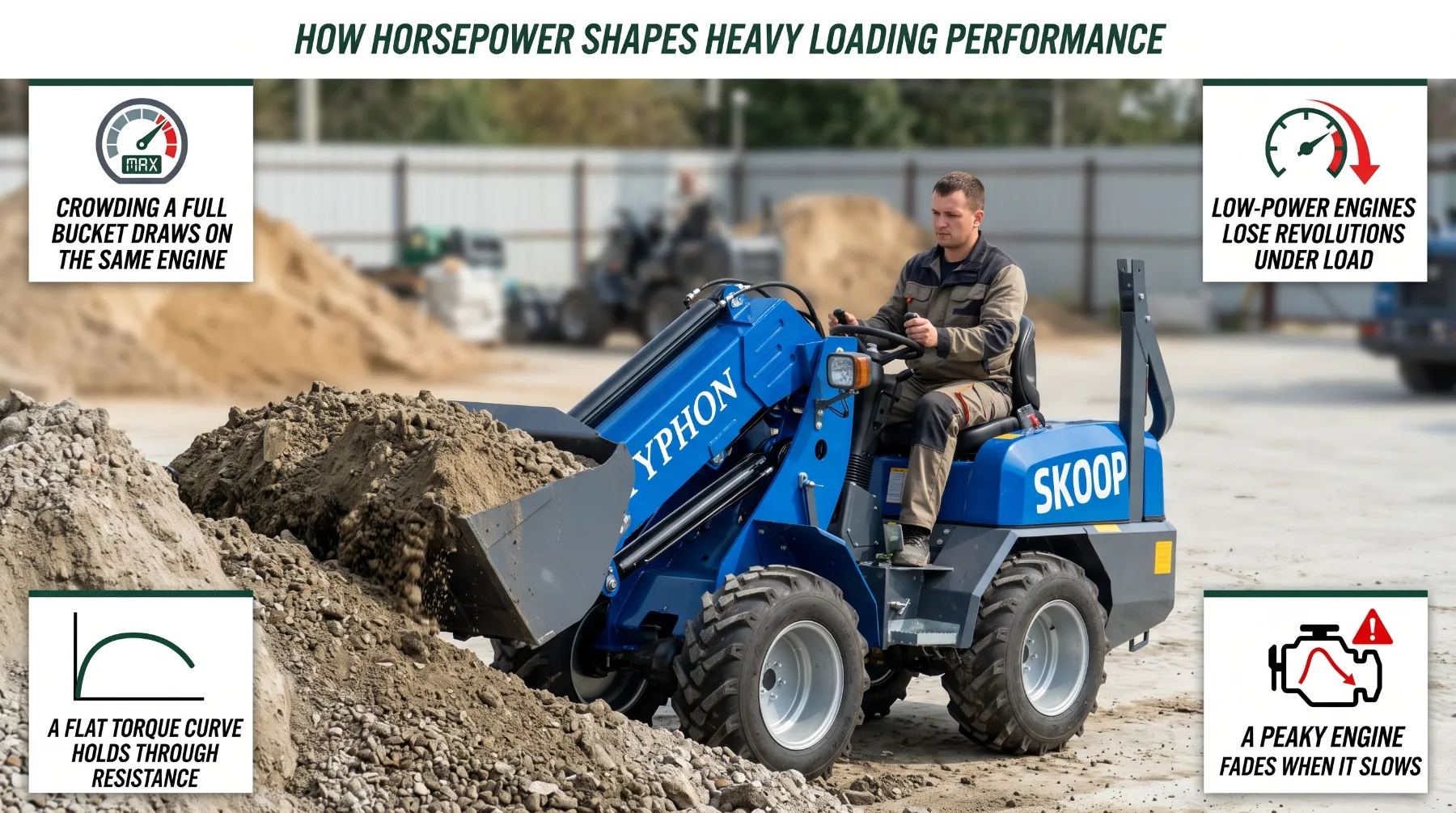
When the bucket is packed to capacity, horsepower and its accompanying torque decide whether the machine keeps working or begins to labor. Crowding a full bucket into a dense pile demands force at the wheels to drive the machine forward and force at the hydraulics to curl and lift, and both draw on the same engine output. A loader with ample power holds its pace through that combined demand, keeping the wheels turning and the arms rising without the engine speed sagging. One short on power loses revolutions the moment resistance climbs, and everything slows with it.
The shape of the engine's torque delivery matters as much as the peak horsepower figure. Heavy loading rarely happens at the engine's most convenient speed, because a full bucket in tough material drags engine speed down. An engine that holds strong torque across a broad band of lower and middle speeds keeps pushing and lifting where a peaky engine would fade and stall. This is why two loaders with identical horsepower ratings can feel entirely different in the pile: the one with a flatter, more generous torque curve carries heavy loads through resistance, while the one that makes its power only near the top of its range struggles the moment it slows.
Key takeaway: Horsepower and broad low-speed torque supply the muscle a full bucket demands, so a loader with strong, well-shaped engine output holds its pace under heavy load where an underpowered one loses speed and labor.
How Hydraulic Flow Shapes Heavy Loading Performance
Horsepower sets the ceiling, but hydraulic flow determines how quickly and forcefully that power reaches the bucket. A heavy load makes this obvious. Lifting a full bucket to dump heightcalls for the cylinders to push hard against considerable weight, and the rate at which the pumps supply fluid decides how fast those cylinders extend. Generous flow lifts a loaded bucket briskly; restricted flow makes the same lift crawl, no matter how much horsepower sits under the hood. On high-cycle loading work, where the machine lifts and dumps hundreds of times a shift, slow lift speed under load quietly drains productivity.
Pressure works hand in hand with flow to define what the hydraulics can accomplish. Flow sets the speed of the lift, while pressure sets the force, and both must suit the weight you handle for the machine to fill and raise a heavy bucket without straining. A well-matched hydraulic system also holds its output steady when the load spikes, so curling a full bucket while lifting doesn't drag the whole function down. When flow and pressure are sized generously and the plumbing is efficient, the loader turns its engine power into fast, strong lifting; when they fall short, that same power sits partly unused because the hydraulics can't deliver it to the cut quickly enough.
Key takeaway: Hydraulic flow and pressure decide how fast and forcefully the engine's power reaches the bucket, so generous, well-matched hydraulics turn horsepower into brisk, strong lifting where restricted flow leaves that power underused.
How Horsepower and Flow Work Together in a Load-and-Carry Cycle
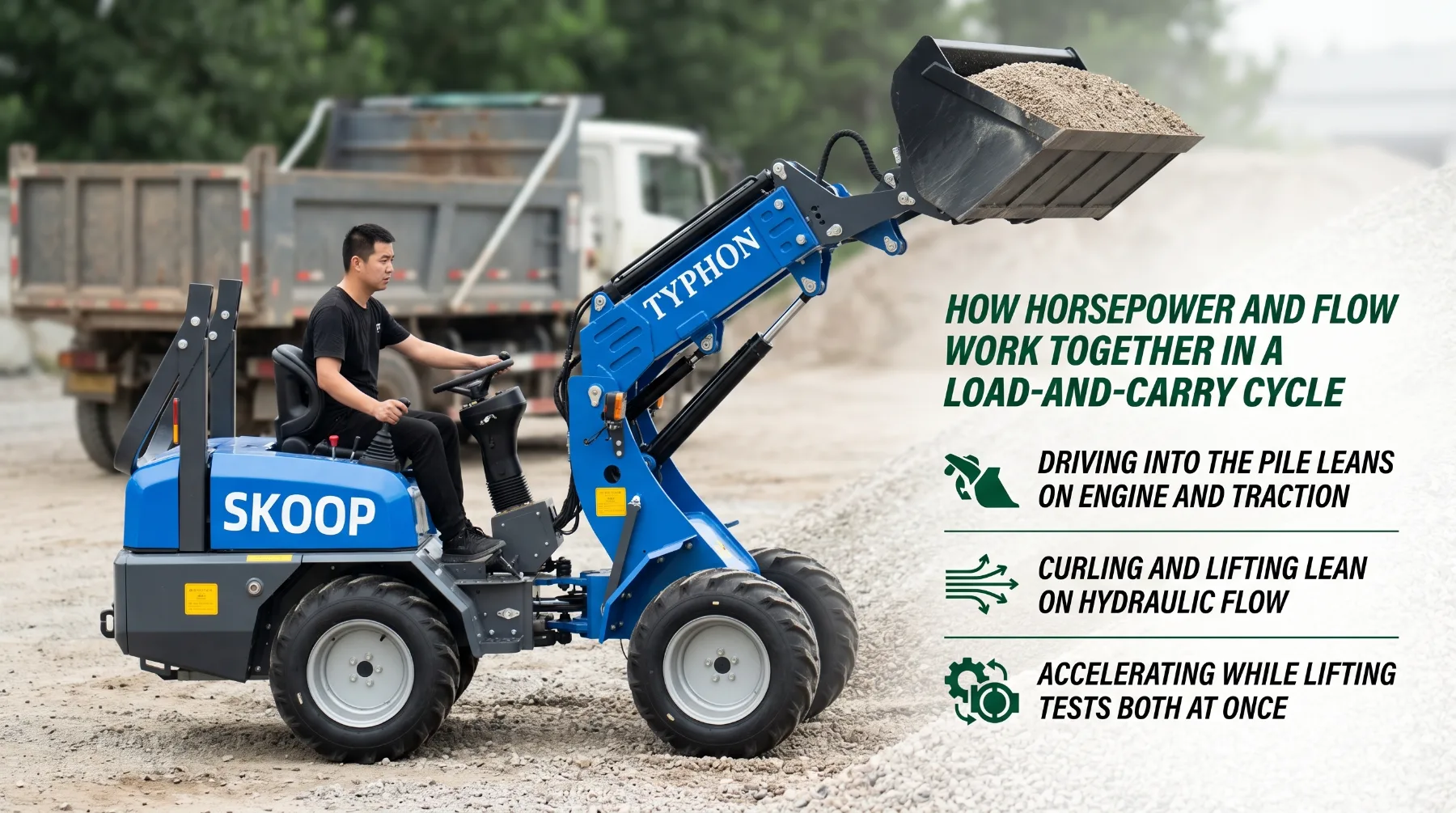
A load-and-carry cycle shows exactly why horsepower and hydraulic flow must cooperate rather than compete. The cycle stacks demands in sequence and often all at once: the loader crowds into the pile, curls and lifts the bucket, reverses out, drives to the truck or stockpile, then raises the arms to dump. Each phase leans on the two systems in shifting proportions. Driving into the pile leans heavily on engine power and traction, curling and lifting lean on hydraulic flow and pressure, and travel leans back toward the drivetrain. The engine feeds all of it from one finite pool of output, distributing power between the wheels and the pumps as the operator works through the cycle.
The most demanding moment comes when the phases overlap. Accelerating away from the pile while raising a full bucket asks the engine to drive the wheels and feed the pumps simultaneously, and that is precisely where a balanced machine proves its worth. A loader with power in reserve and hydraulics sized to match keeps both the wheels turning and the arms rising without forcing a trade-off. An imbalanced machine makes the operator choose: ease the throttle to complete the lift, or slow the lift to keep moving, and either compromise stretches the cycle. Across hundreds of cycles a shift, those lost seconds compound into real losses in material moved. When horsepower and flow are matched, the cycle flows smoothly from pile to truck and back; when they aren't, the machine stumbles at the very point where productivity is decided.
Key takeaway: A load-and-carry cycle constantly shifts demand between the drivetrain and the hydraulics, so horsepower and flow must work together, especially when lifting and driving overlap, to keep the cycle smooth and productive.
How Grades and Tough Site Conditions Shift the Balance
Flat, firm ground flatters any loader, but grades and rough conditions reveal how well horsepower and hydraulic flow hold up together under strain. Driving a full bucket up a ramp forces the engine to haul the entire machine against gravity while still feeding the hydraulics for any lifting, and that combined draw can far exceed anything the loader faces on level ground. On a grade, the demand shifts sharply toward the drivetrain, so a machine short on horsepower begins to slow even before the hydraulics ask for much. The steeper the climb and the heavier the load, the more the engine's reserve, or the lack of it, decides whether the loader holds its pace.
Site conditions layer further demand onto both systems. Soft, muddy, or loose ground robs traction, so the engine works harder to keep the wheels driving through the muck, leaving less output for the pumps. Dense, sticky material resists the bucket and raises the pressure the hydraulics must build to fill and curl it, pulling harder on flow and pressure at the same time. Cold starts, high altitude, and long push distances each add their own tax, thinning the margin the machine has to work with. Under these conditions, an imbalance that stayed hidden on easy ground surfaces immediately, because the machine no longer has spare capacity to mask a weak engine or a starved hydraulic system. Reserve in both horsepower and flow is what turns a punishing ramp or a sticky pile into a routine pass rather than a struggle.
Key takeaway: Grades and tough site conditions raise demand on both the drivetrain and the hydraulics at once, so only a loader with reserve in both horsepower and flow holds its pace where an imbalance quickly surfaces under strain.
Conclusion
Horsepower and hydraulic flow are distinct forces in a wheel loader, but heavy loading binds them tightly together. Horsepower and its torque supply the muscle to drive the wheels and turn the pumps, while hydraulic flow and pressure decide how fast and forcefully that power reaches the bucket. Neither one alone tells you how a machine will perform in the pile. A loader with abundant power but starved hydraulics lifts slowly, while one with generous flow but a weak engine bogs when lifting and driving stack together. The best machines feed both sides in balance, so a load-and-carry cycle flows smoothly from pile to truck even on grades and rough ground. Read both specifications together, match them to your heaviest work, and verify the machine under real load, and your wheel loader will move more material with less strain across every shift.
Frequently Asked Questions
Is horsepower or hydraulic flow more important for heavy loading in a wheel loader? Neither is more important on its own. Horsepower and torque provide power for driving into the pile and running the hydraulic pumps, while hydraulic flow and pressure control how quickly and forcefully the bucket lifts and curls. High horsepower cannot make up for weak hydraulics, and high flow is limited if the engine cannot supply enough power. The best choice balances both systems around the loader's heaviest routine work.
Why does my wheel loader lift a full bucket slowly even though it has high horsepower? The hydraulic system may be the bottleneck. Lift speed depends on the flow reaching the cylinders, while pressure provides the force to handle the load. If the pumps, valves, or plumbing cannot deliver enough flow, the bucket will rise slowly despite high engine horsepower. Check fluid level, filters, and operating temperature as well. If the issue continues, hydraulic capacity may be limiting performance.
How do grades and rough ground change the balance between horsepower and hydraulic flow? Grades and rough ground increase demand on both systems. A full bucket climbing a slope puts more load on the engine and drivetrain, while soft ground increases traction demand. Dense material also requires greater hydraulic pressure for digging and lifting. When these demands combine, limited engine or hydraulic reserve becomes more noticeable. This is why loaders working on difficult sites need adequate capacity in both areas.
Equipment Guidance
Need help choosing equipment for your next job?
Contact KONSTRUCTZ support and get practical guidance before comparing machines, attachments, or jobsite requirements.Contact SupportReader Comments
Join the equipment discussion
Related Posts
No published comments yet.