


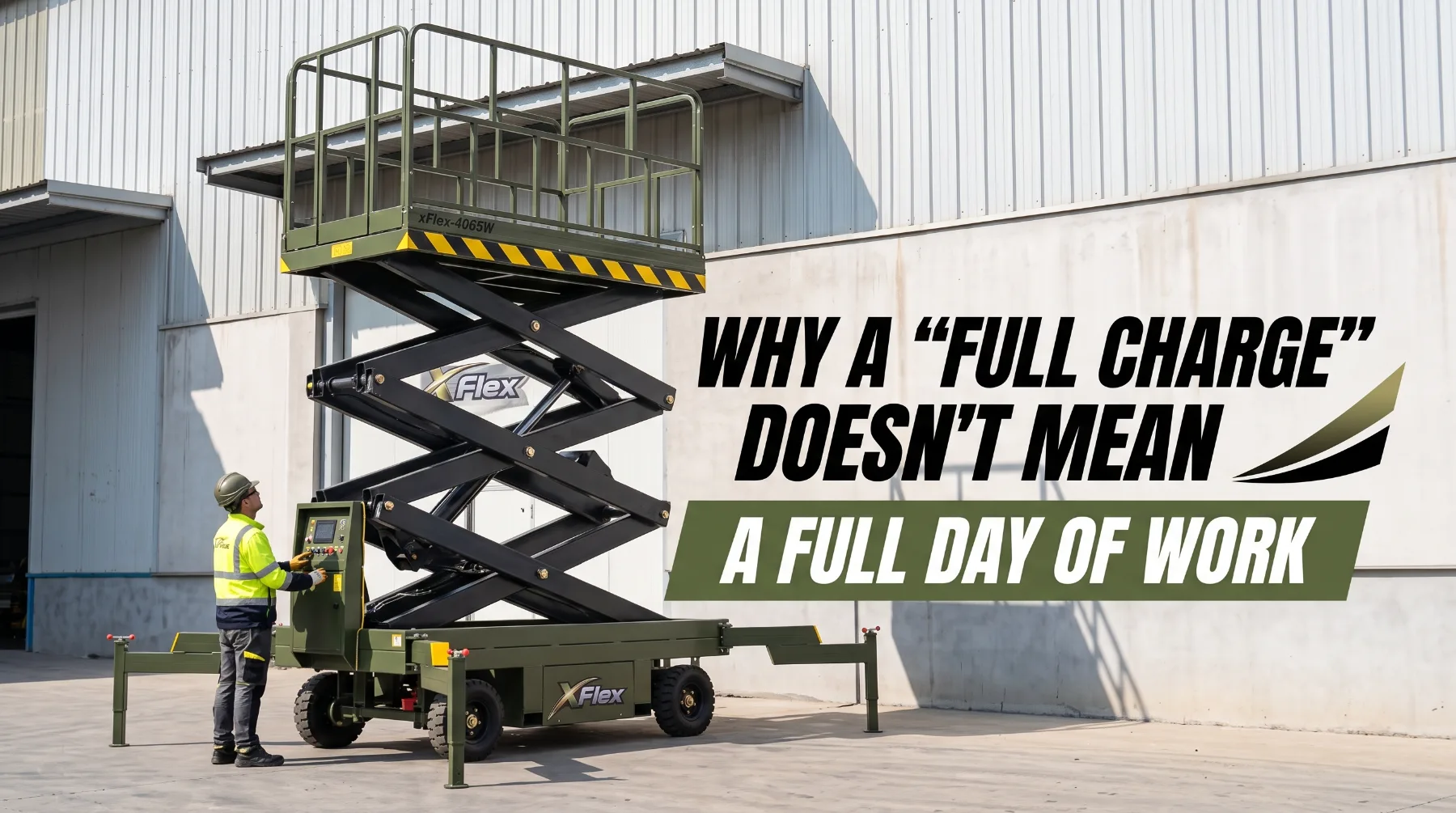
An operator arrives on site at seven, glances at the charge indicator showing a confident 100 percent, and expects the scissor lift to carry the crew through the shift without a hitch. By early afternoon the platform rises more slowly, the machine hesitates when it drives between work points, and the low-battery warning flickers long before the last task is done. Nothing broke, nothing was misused, and yet the lift that promised a full day fell short. This gap between what the gauge shows and what the battery delivers catches site supervisors and rental managers off guard more often than most would admit. A full charge is a starting point, not a guarantee, and understanding why is what separates a smoothly run operation from one that scrambles to cover unexpected downtime.
The charge indicator answers one narrow question: how full is the battery right now? It says nothing about how much usable work that charge represents, how the battery has aged, or how hard the coming shift will push it. Learning to read past the percentage, and to plan around the factors that quietly erode runtime, turns a source of frustration into a manageable, predictable part of your day. This guide explains why a full charge and a full day are not the same thing, and what you can do about it.
What the Charge Indicator Actually Measures
State of charge is what that percentage on the display represents, and it is easy to mistake for something larger than it is. The reading tells you how full the battery is relative to its current capacity, much like a fuel gauge shows how much is in the tank. What it does not tell you is how big that tank has become over the battery's life, and that distinction is where the trouble begins.
A battery's capacity is not fixed. It shrinks gradually with age and use, so a pack that once held enough energy for a full day of raising and repositioning the platform might now hold only two-thirds of that, even when the gauge still climbs to a proud 100 percent. The indicator faithfully reports that the battery is full, but full of a smaller reservoir than it started with. An operator reading only the percentage has no way to sense that the ceiling has dropped.
Think of it the way you would think about a water tank that has slowly developed a leak in its walls, reducing how much it can hold. Fill it to the brim and the level gauge reads full, yet you have less water than you did a year ago. The scissor lift battery behaves the same way, and the charge indicator, honest as it is, only ever describes the level, never the size of the tank behind it.
The Difference Between Rated Capacity and Real-World Capacity
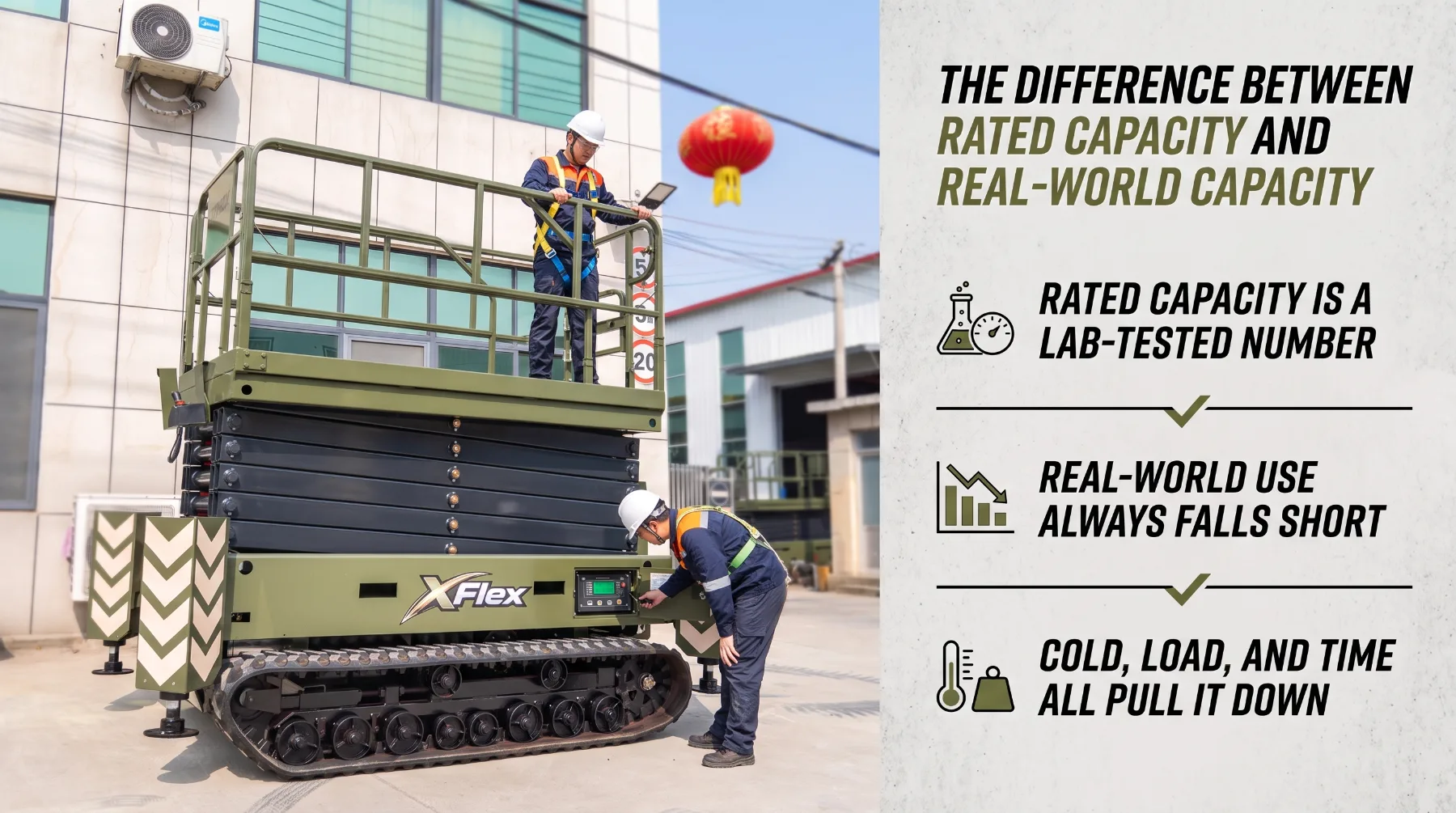
Rated capacity is the figure printed on the battery when it leaves the factory, and it describes performance under ideal laboratory conditions. Manufacturers measure this number with the battery new, at a comfortable temperature, discharging at a controlled and often gentle rate. Those conditions produce an impressive, clean figure, but they rarely match the reality of a busy job site or a working facility floor.
Real-world capacity is what the battery actually delivers where you use the lift, and it almost always falls below the rated number. The moment a battery leaves ideal conditions, its usable energy drops. Cold air, heavy platform loads, frequent full-height raises, and the simple passage of time all pull real capacity below the rating. A pack advertised for a certain run time was tested in a way your operation will never replicate, so treating the rated figure as a daily promise sets you up for disappointment.
This gap matters most when you plan a shift around the numbers. A supervisor who schedules a full day of overhead work based on the rated capacity may find the lift falling short by mid-afternoon, not because anything went wrong, but because the rating was never meant to describe a demanding real shift. Reading the rated capacity as a best-case ceiling, rather than a dependable floor, keeps expectations grounded in what the machine will genuinely do.
Why Battery Age and Health Erode Usable Runtime
Every charge and discharge cycle takes a small toll on a battery, and those tolls accumulate into meaningful capacity loss over the years. A battery is rated for a certain number of cycles before its performance noticeably declines, and as it works through that count, the amount of energy it can store and release steadily shrinks. A three-year-old pack that has cycled daily simply cannot match the runtime it offered when new, regardless of how full the gauge reads.
State of health is the term that captures this decline, expressing current capacity as a share of the original. A battery at 80 percent state of health holds only four-fifths of the energy it once did, so even a full charge delivers roughly four-fifths of the runtime it used to. Two scissor lifts sitting side by side in the yard, both showing 100 percent, can support wildly different amounts of overhead work if one pack is fresh and the other is worn.
Maintenance history compounds or eases this aging depending on how the battery was treated. Lead-acid packs that missed their watering schedule, batteries routinely discharged too deeply before someone finally plugged them in, and packs left to charge in punishing heat all age faster than their cycle count alone would suggest. Understanding the health and history of each battery in your fleet explains why some lifts reliably finish a shift while others fade early, even when they charged to the same percentage the night before.
How Temperature, Load, and Duty Cycle Reduce What You Get
Temperature exerts a powerful and often underestimated pull on usable capacity. Cold conditions slow the chemical reactions inside a battery, reducing the energy it can release, so a scissor lift working in an unheated warehouse or an exposed outdoor site in winter will run noticeably shorter than the same machine in a mild environment. Excessive heat causes its own harm, accelerating wear and stressing the pack even as it operates. The battery performs best in a moderate range, and the further your conditions drift from it, the less runtime a full charge buys. Including temperature checks in a safety checklist helps operators identify conditions that could affect battery performance, runtime, and safe machine operation.
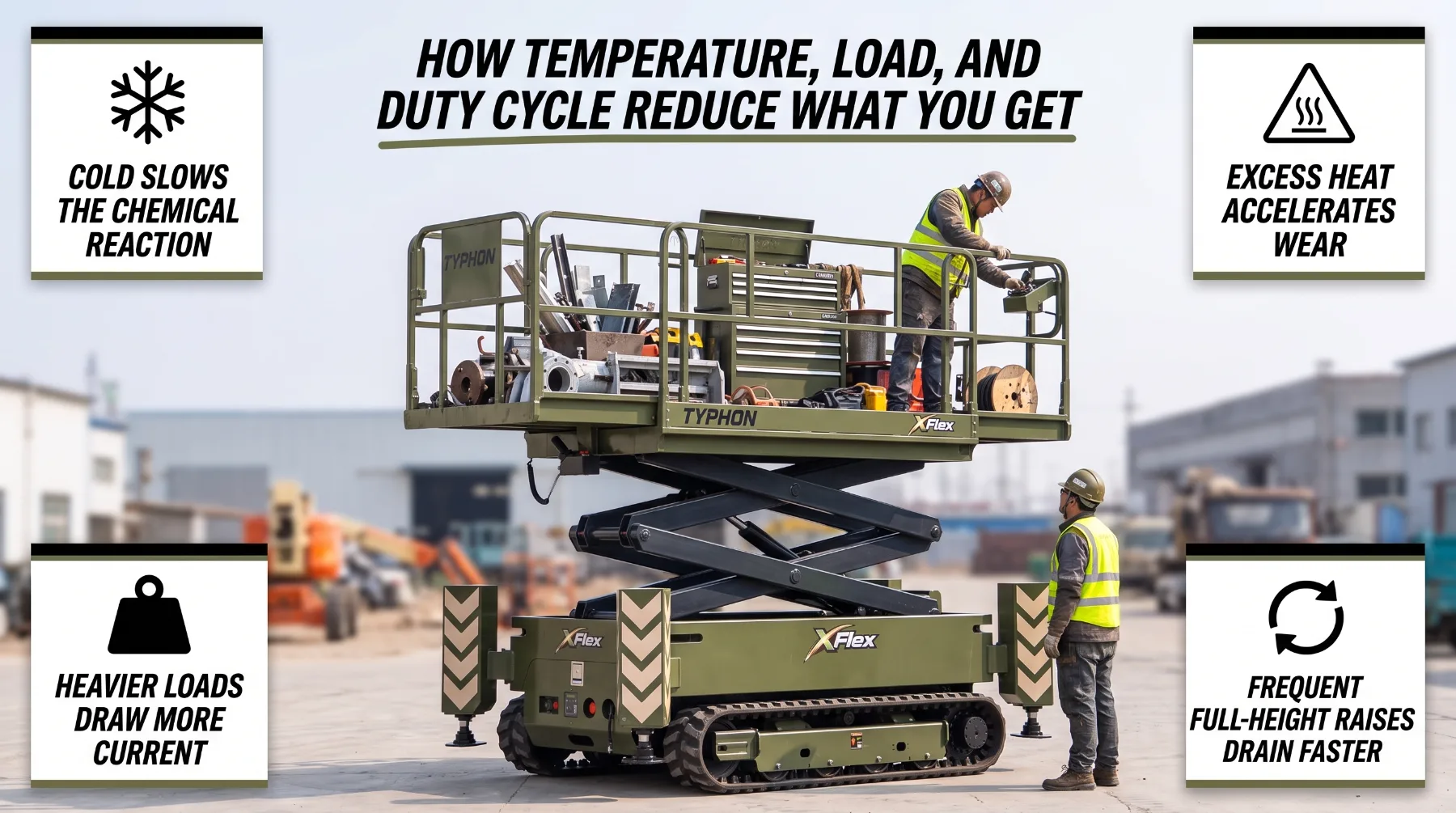
Load intensity draws down the battery in direct proportion to the effort you demand. A lift raising a full platform of workers, tools, and materials to its maximum height, and doing so again and again, pulls far more current than one lifting a single technician a short distance for a quick task. Heavier platform loads and taller lifts empty the battery faster, so two machines starting at a full charge can reach empty at very different times depending on the work they carry through the shift.
Duty cycle ties these factors together into the rhythm of the whole day. A lift cycling constantly, raising and lowering with barely a pause and driving often between work points, works its battery relentlessly and drains it quickly. A machine with natural gaps in its schedule, holding position while a crew works overhead and resting between moves, sips its charge more slowly and stretches further into the shift. When you combine a demanding duty cycle with heavy platform loads and an unfriendly temperature, the runtime a full charge provides can fall dramatically below what the same battery would deliver under gentler conditions.
The Hidden Cost of Partial Charging Habits
Charging routines shape not only how much energy a battery holds on a given morning but how well it holds energy over the long run. Lead-acid batteries in particular suffer when they are charged in short, frequent bursts rather than allowed to complete a full cycle with an occasional equalizing charge. These habits leave the pack chronically undercharged and speed its decline, so a battery treated this way delivers less usable runtime and reaches the end of its life sooner.
Interrupted charges create a more immediate problem by leaving a battery less than truly full when a shift begins. An operator who unplugs a lead-acid pack early, believing a couple of hours on the charger is enough, sends the lift out with a partial charge that the gauge may generously round up. The machine starts the day already behind, and the shortfall shows itself well before the overhead work is finished.
Lithium-ion batteries tolerate partial and opportunity charging far better, which is one of their genuine advantages, yet even they benefit from sound charging discipline and suffer when charged in extreme heat or pushed through poor practices. Whatever the chemistry, the way a crew charges its lifts day after day quietly determines how much of a full charge is real and how long each pack will keep delivering it. Good charging habits protect the runtime you paid for.
Conclusion
A charge indicator reading 100 percent tells you the battery is full, but full has quietly become a moving target that shrinks with age, cools with the weather, and empties faster under heavy overhead work. The rated capacity printed at the factory describes an ideal your site will never quite reproduce, while real-world capacity reflects the battery's health, the temperature around it, the loads the platform carries, and the rhythm of the shift it faces. Partial charging habits erode that capacity further, and a pack near the end of its cycle life simply cannot deliver the day it once did. None of this means electric scissor lifts fall short of expectations. It means the smart operation plans around what its batteries actually deliver rather than what a percentage implies. Measure your true runtime, match healthy packs to demanding work, guard the charging environment, and train operators to work efficiently, and a full charge will carry you far closer to a full day. When you are ready to build a fleet and a charging strategy sized for the work your operation truly demands, a trusted equipment specialist can help you match dependable equipment to the results you count on.
Frequently Asked Questions
Why does my scissor lift show a full charge but still die before the shift ends?A full reading does not mean the battery still has its original capacity. Aging, cold temperatures, heavy loads, and frequent lifting can reduce runtime. If the lift dies early despite showing full, the battery may have lost capacity.
How can I tell how much real runtime my scissor lift battery has left?Track how long the lift operates under normal working conditions and compare it with its original runtime. Lithium-ion batteries can show state of health, while lead-acid batteries can be checked with a capacity or discharge test.
Does charging my scissor lift battery more often help it last a full day?It depends on the battery type. Lithium-ion batteries can handle opportunity charging during breaks, while lead-acid batteries generally perform better with full charging cycles and proper maintenance.
Equipment Guidance
Need help choosing equipment for your next job?
Contact KONSTRUCTZ support and get practical guidance before comparing machines, attachments, or jobsite requirements.Contact SupportReader Comments
Join the equipment discussion
Related Posts
No published comments yet.